
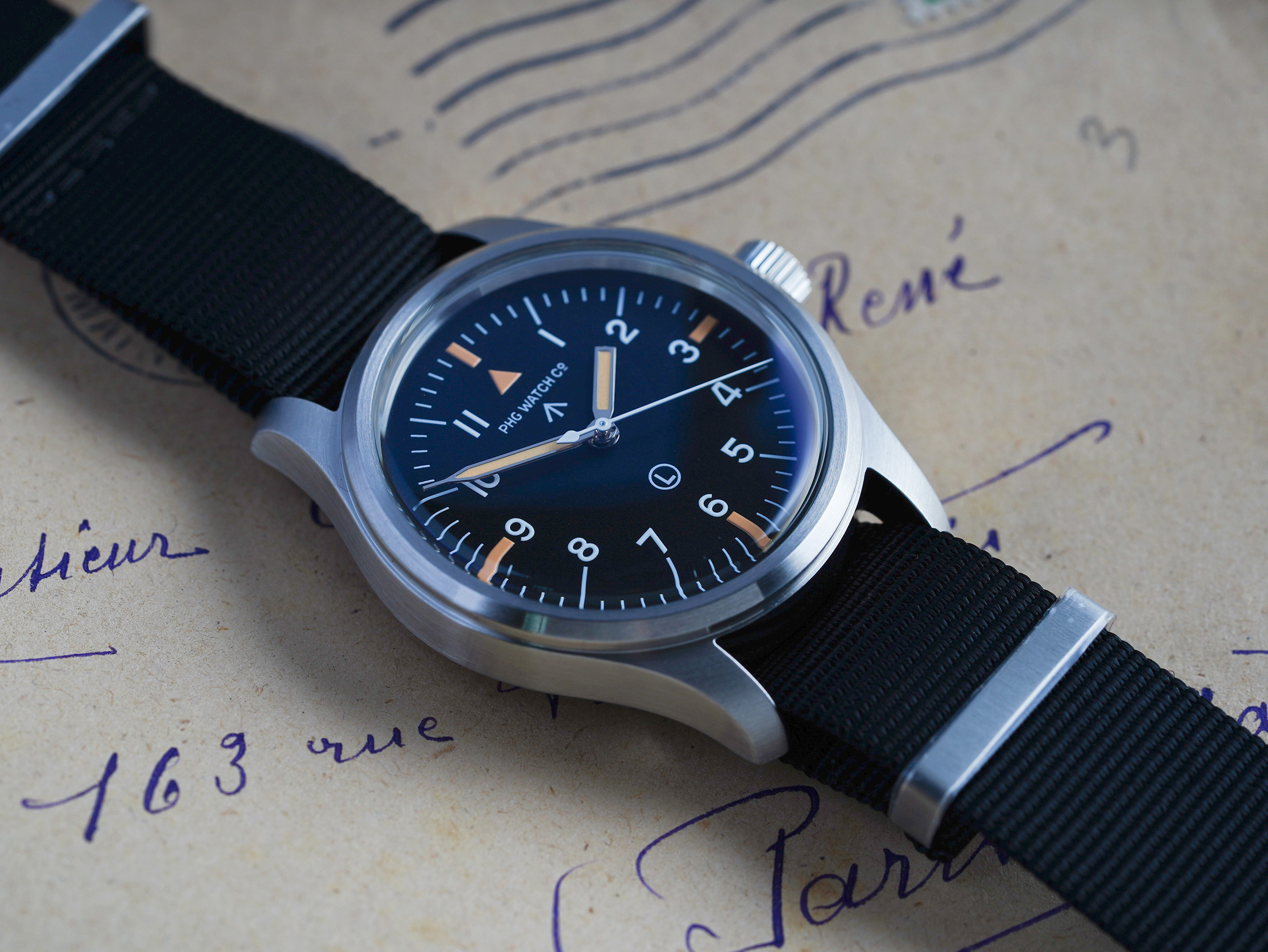
There is a conversation in watch circles that needs to end: the idea that quartz movements are somehow less legitimate than mechanical ones.
It isn’t true. It was never true. And for a tool watch — a watch whose primary job is to be accurate and reliable under adverse conditions — quartz is often the objectively better choice.
The Accuracy Gap Is Not Close
A well-regulated mechanical movement gains or loses 5–10 seconds per day. Over a year, that’s up to 60 minutes of accumulated error. A standard quartz movement gains or loses ±15 seconds per month. The difference isn’t subtle — it’s roughly 100:1 in favour of quartz. For a watch being used to coordinate timing, navigation, or any real operational task, this matters enormously.
The original British military specification for field watches included quartz movements in the 1970s precisely because the army needed accuracy, not heritage.
MIYOTA 1L45: Two Hands and a Subsidiary Seconds
Two of our four Heritage Series references — the KM-1940 and the WO-1945 — use the subsidiary-seconds configuration: hours and minutes on the main dial, with a small running seconds at 6 o’clock. No central sweep second. This is the historically correct layout for both the German Kriegsmarine deck watch and the British WWW Dirty Dozen. For this configuration, we use the MIYOTA 1L45, a Japanese-made two-hand quartz calibre with subsidiary seconds. The dial centre remains clean. The seconds can be read without dominating the display.
Seiko VH31: The Centre-Sweep Option
The other two references — the RAF-1948 (Mark XI) and the W10-1967 (Smith W10) — are three-hand watches with a centre sweep second. The Mark XI never had a subsidiary seconds dial; its sweep second was the primary timing reference for the pilot. The Smith W10 likewise used a full three-hand layout.
For these watches, we use the Seiko VH31. What distinguishes the VH31 is its stepping motor, which produces a smooth, continuous sweep rather than the one-beat-per-second tick of cheaper quartz movements. At a glance, it reads like a mechanical — which is either a feature or an irrelevance, depending on your perspective. We think it’s a feature.
Both movements are accurate. Both are reliable. Both are serviceable anywhere in the world without specialist tools. Both allow PHG to deliver specification-correct watches at prices that don’t require a financial conversation.
The romance of mechanical horology is real. But if the watch is going to work, quartz is how it works.
