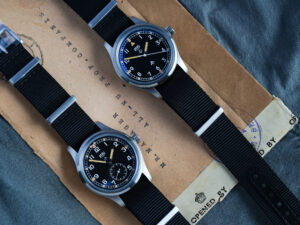
Naval watches were never about the ocean. They were about the ship — the instrument room, the chart table, the 4 a.m. watch rotation when attention was the only thing standing between the vessel and the reef.
PHG’s Naval Series draws from that specific discipline. Two watches, two lineages, one requirement: you must be able to read the time without thinking about it.
KM-1940: The Kriegsmarine Deck Watch
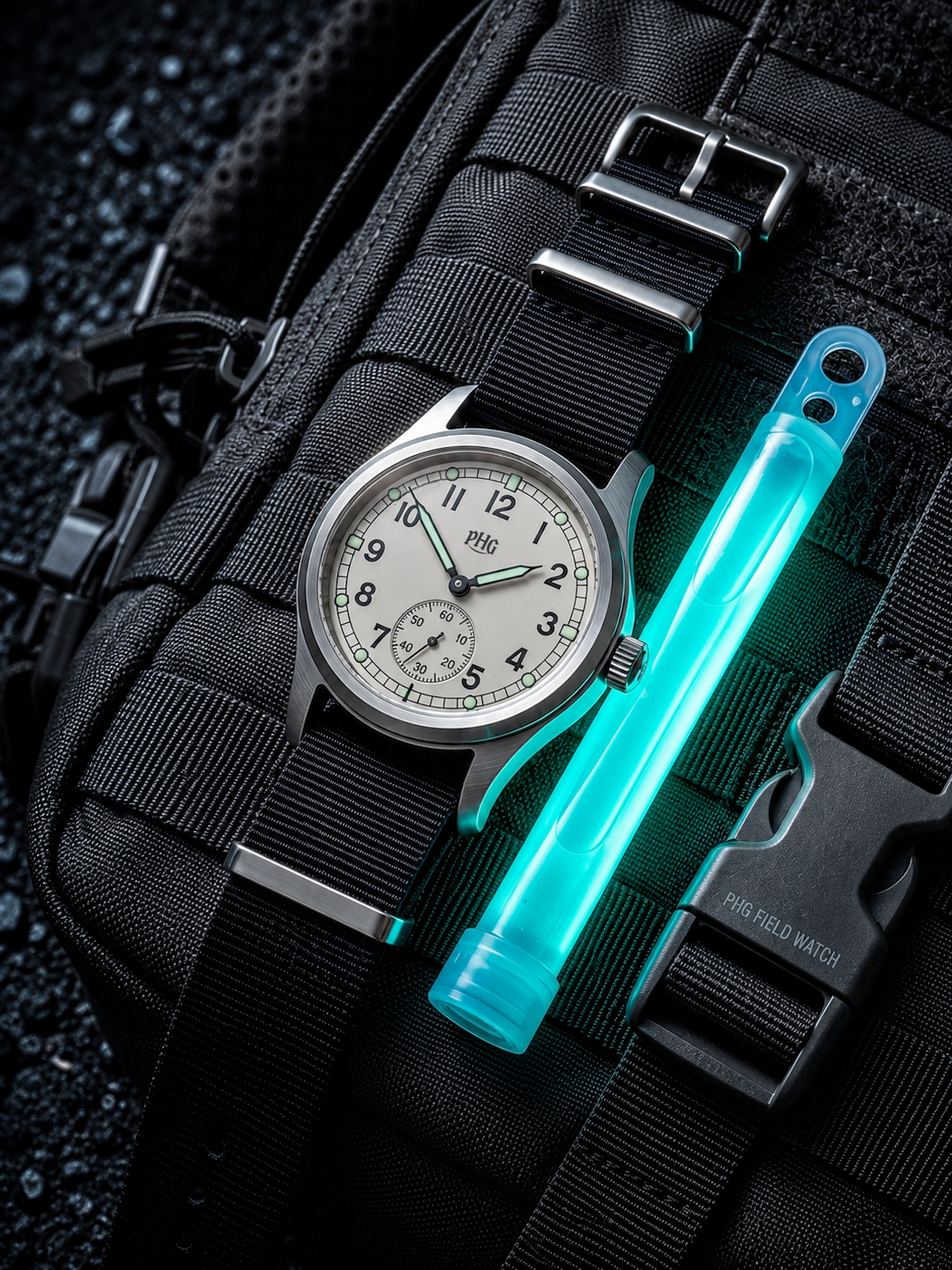
The KM-1940 references the Zentra KM — the wristwatch issued to German Kriegsmarine deck personnel during the Second World War. It is not a B-Uhr. That is an important distinction.
The B-Uhr (Beobachtungs-Uhr, or observer’s watch) was a large-format Luftwaffe instrument watch, defined by its oversize onion crown and rotating inner chapter ring. The Kriegsmarine deck watch was a different brief entirely: a standard wristwatch sized for the wrist, designed for the specific conditions of surface ship duty. Not the cockpit — the deck.
Deck duty means high salt spray, strong overhead light, and a need to check the time while operating rigging, instruments, or machinery with both hands occupied. The KM deck watch addressed this with a white high-contrast dial — legible against sea glare where a dark dial loses definition — baton hands, and clear Arabic numerals. No rotating bezel, no elaborate complications. Just the time, readable in a glance, in the worst conditions a surface ship can offer.
The KM-1940 uses the MIYOTA 1L45 — a two-hand quartz calibre with a subsidiary seconds dial at 6 o’clock, matching the original layout. Hours and minutes prominent. Seconds readable when needed, not dominating the dial.
WO-1945: The Dirty Dozen
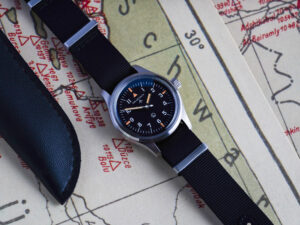
The WO-1945 references the British “Dirty Dozen” — the twelve manufacturers commissioned by the War Office in 1945 to produce a standardised field and service watch to the WWW specification. The designation (Waterproof Wristwatch Watch, yes, intentionally redundant) was issued across all services. The army wore it. So did the navy.
The Dirty Dozen brief was rigorous: black dial, luminous Arabic numerals, subsidiary seconds at 6 o’clock, stainless steel case, standardised dimensions. Twelve manufacturers, one specification. The WO-1945 carries that same subsidiary seconds layout, and uses the MIYOTA 1L45 for the same reason as the KM-1940: it is historically correct.
316L Steel and the Corrosion Question
316L stainless steel is the marine-grade alloy. The “L” denotes lower carbon content, which translates to better resistance to intergranular corrosion — the kind that salt spray accelerates over time. It is the same alloy used in surgical implants and offshore equipment. On a watch case going near seawater, it matters.
Paired with a NATO strap — which dries in hours and breathes against the skin — the Naval Series is a working instrument. The K1 glass crystal won’t cloud in UV light. The case won’t pit. The strap won’t rot.
Some watches are built to last. These are built to be used until they’re no longer needed, and then passed on.